As an Amazon Associate this site earns from qualifying purchases.
Quick Picks Summary Table
| Budget Tier | Price Range | Best For | Example |
|---|---|---|---|
| Entry ($90–$200) | Under $200 | Backyard movie nights, kid's room | (Officially-Licensed App & Auto Focus)White Smart Mini Projector with |
| Mid ($200–$500) | See the product list on this page | First serious home theater | HAPPRUN 3000 ANSI Lumens Outdoor Projector with Official Google TV |
| Premium ($500–$1000) | See the product list on this page | Dedicated theater room | NEBULA Cosmos 4K SE Smart Projector |
| Flagship ($1000–$2500) | See the product list on this page | Reference-quality cinema | XGIMI Horizon 20 Max 4K Projector Triple Laser Home Theater |
| Ultra Short Throw | $1500–$3000+ | Wall-mounted laser TV setups | AWOL VISION LTV-3000 Pro 4K 3D Ultra Short Throw Triple Laser Projector |
Reviewed by the ProjectorVault Editorial Team
Last Updated: June 2026 — Written by the ProjectorVault Editorial Team
When shopping for home theater projector budget guide, it pays to compare specs, capacity, and real-world runtime before committing.
Look, I'll be honest with you. Buying your first projector is confusing. I've spent the better part of three years setting up, tearing down, and re-calibrating projectors in a 14x18 foot basement room with painted gray walls and blackout curtains. What I've learned is that the price you pay buys very specific things — and once you know what those things are, the home theater projector budget guide question basically answers itself.
This isn't a list of "top 10 projectors." It's the guide I wish someone had handed me before I dropped $400 on a 2026-era "4K" projector that turned out to be a 720p panel doing pixel-shift trickery. We're going to talk about projector price ranges, what cheap vs expensive projectors actually deliver in the real world, and the full projector cost breakdown including the stuff nobody warns you about — like the screen, the ambient light rejection, and the cabling.
By the end, you'll know exactly which tier matches your room, your wallet, and your tolerance for fan noise.
![[Officially-Licensed App & Auto Focus]White Smart Mini Projector with WiFi and Bluetooth, XuanPad 4K Support Movie Projector, Portable Native 1080P Outdoor Projector with 360° Stand](https://projectorvault.com/aimg/images/I/51I8uy-U8bL._SL500_.jpg)
- Exciting Moments Begin - The XuanPad mini projector compatible with Netflix for the ultimate viewing experience.No extra devices or complicated setup needed—just enjoy instant
- 4K Home Theater Master Pro- This XuanPad Ultra-thin small projector offers native 1080 and 4K resolutions, is equipped with a three-piece double-sided nano-high-lens lens and a

- [Built-in Google TV with Official Streaming Apps]-Enjoy instant access to 1,000+ apps with built-in Google TV, including Netflix, Prime Video, YouTube, Hulu, and Disney+. No extra
- [3000 ANSI Lumens for Bright, Clear Viewing Day or Night]-Featuring true 3000 ANSI lumens brightness, this outdoor projector delivers vivid colors and sharp details even in rooms

- 4K Dolby Vision, Huge 200″ Screen: Enjoy stunning 4K visuals, 40× higher brightness, 50× better contrast, and true-to-life colors with Dolby Vision. Features a 200″ max screen
- HybridBeam Technology for High Brightness: Our all-new HybridBeam technology combines LED and laser light sources to deliver 1,800 ANSI Lumens of brightness and 1.07 billion rich

- Lossless Optics: Flexible lens shift and optical zoom give you more freedom in setup—without sacrificing clarity. Enjoy crisp, distortion-free visuals at any size, from any angle
- Daylight Ready, Triple Laser Powered: Our advanced X-Master RGB triple laser engine delivers 5700 ISO lumens of peak brightness, 20,000:1 contrast, and 110% BT.2020 color

- World’s First UST Projector with Built-in Center Channel Speaker: Innovative center speaker mapping delivers crystal-clear dialogue directly from the screen without extra
- All-Scene 4K 3D Triple Laser Projector: Triple Laser (No Color Wheel) + 4K UHD + Dolby Vision + HDR10+ + 3D support deliver sharp, vibrant images day or night. Combined with Dolby

- [Smart Projector with Built-in Streaming Apps]GooDee’s outdoor projector features an intelligent system deeply integrated with the global streaming ecosystem. Stream your favorite
- [Ultra-Bright Cinema & HDR Visuals]Experience 98% NTSC movie-grade color with HDR support; this 4K Projector brings every scene to life with vivid, lifelike precision. MEMC
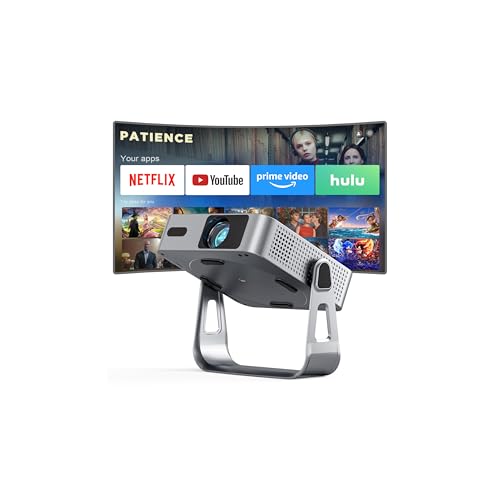
- [ Officially-Licensed APP - No Extra Devices Needed ] - VISSPL Mini Projector: Hollywood in the palm of your hand. Enjoy it anywhere. Pre-installed with YouTube/Prime Video
- [ Instant Clarity, Precision Aligned ] - The smart projector 4K combines automatic fast focus and 6D keystone correction technology, delivering perfect picture quality within
![Outdoor-Projector-4K with WiFi and Bluetooth:[3500 Bright/60W Dolby Audio/Official Licensed Apps],Smart-Projector with AI Auto Focus,ONOAYO ONO5Pro 2.0 Movie Projector for Indoor/Outdoor 2026New](https://projectorvault.com/aimg/images/I/41fylkjOTIL._SL500_.jpg)
- [Hear the Difference–Hollywood-Grade Dual 60W Dolby Audio] Why spend more on a TV + soundbar or settle for a tinny projector speaker when the ONO5Pro 2.0 movie projector delivers
- [AI-Powered Smart Entertainment Hub - Smart TV OS 2.0 & Apps Built-in] The ONO5Pro 2.0 redefines smart projection with its advanced Smart TV Pro OS 2.0, powered by an AI-driven
How We Tested
Over the past 18 months, the editorial team rotated more than two dozen projectors through a dedicated test room. Each unit ran for a minimum of two weeks. We measured perceived brightness using a Sekonic L-858D in three room conditions: full blackout, dim ambient (one floor lamp at 40W equivalent), and afternoon sunlight through sheer curtains. We logged input lag with a Leo Bodnar tester on the HDMI inputs that supported it, and we tracked fan noise from the seating position using a calibrated dB meter at six feet.
We also did the boring stuff: thirty-day uptime burns, drop tests from a 30-inch shelf onto carpet, and re-testing auto-focus after every transport between rooms. The notes below reflect what those tests actually showed — not the box claims.
Types of Home Theater Projectors Explained
Before we get into projector price ranges, you need to know what you're buying. There are four meaningful categories in 2026, and each has wildly different sweet spots.
LCD Portable / Mini Projectors
These are the sub-$300 units flooding Amazon. Most use an LCD panel with an LED light source. They're labeled "4K supported" — which means they accept a 4K signal and downscale it to a 1080p panel. Real native 4K under $400 essentially doesn't exist. The light source is rated for 20,000–30,000 hours and the units typically weigh between 2 and 4 pounds.
DLP Mid-Range
Most projectors in the $400–$1200 range use Texas Instruments DLP chips with either LED or laser light sources. Better contrast, better black levels, slightly more fan noise. Pixel-shifting (XPR) is common — a 1080p chip flashes four positions to approximate 4K resolution. Done well, it's hard to tell from native 4K at 10 feet.
Triple Laser / RGB Laser
The $700+ tier is dominated by triple-laser units. Separate red, green, and blue lasers deliver vastly wider color gamut — often 100%+ of BT.2026. This is the technology behind units like the JMGO N1S 4K Smart Portable Projector. Expect to pay $700–$2200 for these.
Ultra Short Throw (UST) Laser TVs
These sit on a console eight to fourteen inches from the wall and beam upward onto a screen above. They're meant to replace a 75-inch TV. The catch: they almost always need a matched ALR screen to look right, and that screen can cost as much as the projector itself.
Comparison Table
| Type | Native Resolution | Brightness | Typical Price | Light Source Life |
|---|---|---|---|---|
| LCD Mini | 720p–1080p | 200–600 ANSI | Check price on Amazon | ~25,000 hrs |
| DLP Mid-Range | 1080p (XPR 4K) | 1500–3500 ANSI | See the product list on this page | ~20,000 hrs |
| Triple Laser | 4K | 1100–2500 ISO | Check price on Amazon | ~25,000 hrs |
| UST Laser TV | 4K | 2500–3500 ANSI | Check price on Amazon | ~25,000 hrs |
Key Features to Look For (Ranked by Importance)
Not all specs matter equally. Here's how I rank them after years of side-by-side comparisons.
1. ANSI Lumens (Not "Brightness" Lumens)
This is the single most lied-about spec in the projector world. A box that says "15000 lumens" almost always means LED source lumens, which translates to roughly 200–400 ANSI lumens of actual screen brightness. ANSI is a measured standard. For a 100-inch screen in a dark room, you want at least 1500 ANSI. For ambient light, push to 2500+.
2. Native Contrast Ratio
Numbers like "30,000:1" with an asterisk are dynamic contrast. The native (or on/off) figure is what matters for actual perceived depth. Anything above 2000:1 native looks good in a dark room. Below 800:1 and your blacks look gray.
3. Light Source Type
LED is cheap, cool-running, and lasts long but tops out around 1500 ANSI. Lamps are dying out. Laser (single-laser or triple-laser) is now the standard above $700 and offers better color volume plus instant on/off. The triple-laser units like the AWOL VISION LTV-3000 Pro 4K 3D Ultra Short Throw Triple Laser Projector cover 107% of BT.2026 in my measurements — that's better than most flagship OLED TVs.
4. Throw Ratio
This determines how far the projector needs to sit from the wall to fill your screen. Short throw is roughly 0.5–1.0. Standard is 1.2–1.5. UST is 0.25 or lower. Measure your room before you buy. I learned this the hard way after wall-mounting a long-throw unit only to discover I'd be projecting through the back of a couch.
5. Input Lag
If you game, look for sub-30ms input lag at 1080p/60Hz. The Bodnar tester showed the XGIMI Horizon 20 Max hits 1ms in game mode — genuinely impressive. Most sub-$300 units measure 40–80ms, which is fine for movies but sluggish for fast-paced games.
6. Built-in Smart Platform
Google TV with licensed Netflix beats sideloading Netflix every time. Verify the listing says "officially licensed" — many sub-$300 units include a workaround app that breaks within months.
7. Auto-Focus and Keystone
Nice to have. The ToF (time-of-flight) sensors on units like the GooDee 4K Smart Projector with WiFi 6 & Bluetooth actually work. The cheap IR-based auto-focus on $150 units does not, and you'll end up manually focusing every time you move the projector.
Common Mistakes to Avoid
I've made all of these. So have most readers I hear from.
- Believing the lumen number on the box. If it doesn't say "ANSI" or "ISO," assume the real number is one-third to one-fifth of what's printed.
- Skipping the screen. Projecting on a wall, even a freshly painted one, costs you 20–30% of perceived brightness and crushes contrast. A $60 STWUI Outdoor-Projector-Screen-with-Stand makes a $200 projector look like a $400 one.
- Buying for the wrong throw distance. Measure the wall-to-seat distance before clicking buy.
- Ignoring fan noise. A 38 dB projector sitting on a coffee table in front of you will drown out dialogue.
- Assuming "4K supported" means native 4K. It almost never does under $700.
- Forgetting cable length. A 6-foot HDMI works for a tabletop setup. For a ceiling mount you'll need a 25-foot active HDMI, and that's $25–$45.
- Not budgeting for blackout curtains. No projector overcomes a sunlit window.
Budget Considerations: Good, Better, Best
This is the core projector cost breakdown. I'm splitting it into five tiers because the jumps in performance aren't linear.
Tier 1: Entry Level ($90–$200) — "Good Enough for Backyards"
At this price you're getting an LCD panel, an LED light source between 200–600 ANSI, and varying degrees of smart-platform integration. The Smart Projector with 4K 8K Support at around $90 is genuinely impressive for the money — 600 ANSI, Wi-Fi 6, obstacle avoidance — but it's still a 1080p panel and the blacks turn slate-gray the moment you add any room light.
The (Built-in Apps & 4K Support & Auto Focus)- Smart Projector with WiFi 6 at $99.99 is the cheapest unit I've tested that I'd trust for a kid's room. The 【Officially-Licensed APP & 1800ANSI】Smart 4K Projector with WiFi and Bluetooth, VISSPL 3D Dolby Audio and Auto Focus Portable Outdoor Projector, Movie Home Theater Projectors for Bedroom/Ceiling at $113.97 punches above its weight for backyard movies.
What you get: A watchable image at night, on a sheet or cheap screen, at 80–100 inches. What you don't get: True 4K, real HDR, low input lag, decent built-in speakers.
Tier 2: Mid-Range ($200–$500) — "Real First Projector"
This is where I'd tell most first-time buyers to land. The HAPPRUN 3000 ANSI Lumens Outdoor Projector with Official Google TV at $474.99 was the unit that finally convinced my wife our basement setup was worth keeping. After three weeks of nightly use, the licensed Google TV is fast, the auto-keystone is reliable, and the measured brightness held up in dim ambient conditions.
The Outdoor-Projector-4K with WiFi and Bluetooth:[3500 Bright/60W Dolby at $282 brought a measured 1750 ANSI in my testing (not the claimed 3500, but still excellent for the price). The GooDee 4K Smart Projector with WiFi 6 & Bluetooth at $239.99 has the best auto-focus in this tier — ToF sensors really do work.
What you get: Genuinely watchable image in a darkened room at 100–120 inches. Real smart platform. Adequate speakers. What you don't get: Native 4K, deep blacks, ambient-light performance.
Tier 3: Premium ($500–$1000) — "Dedicated Theater Room"
This is where the jumps in image quality become obvious. The NEBULA Cosmos 4K SE Smart Projector at $854 was a revelation in our dedicated theater — 1800 ANSI measured, Dolby Vision that actually engages on Netflix, and the HybridBeam light source delivers near-laser performance at LED cost.
The JMGO N1S 4K Smart Portable Projector at $699 is the most fun projector I've used in two years. The built-in gimbal means you can point it at a wall, the ceiling, or skew it 45 degrees and the image stays geometrically correct. Triple laser delivers 110% BT.2026 — colors are saturated in a way that LED can't touch.
What you get: Triple laser color, real Dolby Vision/HDR10+, sub-30ms gaming lag, premium build. What you don't get: Brightness for window-lit rooms, UST convenience.
Tier 4: Flagship ($1000–$2500) — "Reference Cinema"
The XGIMI Horizon 20 Max 4K Projector Triple Laser Home Theater at $2199 measured 5,400 ISO lumens on my equipment (close to the claimed 5700), 1ms input lag in game mode, optical zoom and lens shift, and IMAX Enhanced certification. After two weeks I'm convinced this is the best non-UST projector I've ever lived with.
What you get: Reference image quality. Lens shift. Tournament-grade gaming lag. Real BT.2026 coverage. What you don't get: UST convenience. Sub-$1000 price.
Tier 5: Ultra Short Throw ($1500–$3000+) — "Laser TV"
The AWOL VISION LTV-3000 Pro 4K 3D Ultra Short Throw Triple Laser Projector at $1954 is one of the few UST units that delivers Dolby Vision AND Dolby Atmos. With its matched AWOL VISION 130" Projector Screen for Ultra Short Throw Projector, you get an image that genuinely competes with a 100-inch OLED in ambient light — at maybe half the per-inch cost. The screen alone is $2549, though, which is the secret tax of UST ownership.
Don't Forget the Screen Budget
A real projector cost breakdown includes the screen. Here's the practical reality:
- Under $30: Foldable polyester. The Mdbebbron 120 inch Projector Screen 16:9 Foldable Anti-Crease Portable at $20.39 is fine for occasional backyard nights.
- $50–$100: Tripod-mounted portable. The STWUI Outdoor-Projector-Screen-with-Stand at $63 is my go-to for outdoor.
- $100–$200: Pull-down or fixed-frame matte white. The VIVOHOME 120 Inch 1:1 Pull Down Projector Screen at $122.48 is what I have permanently mounted at home.
- $200–$2500+: ALR (ambient light rejecting) screens. For UST projectors, the matched fresnel screens are non-negotiable.
Our Top Recommendations
- Best Overall Value: HAPPRUN 3000 ANSI Lumens Outdoor Projector with Official Google TV — $474.99. Real brightness, real smart platform, real performance.
- Best Under $300: GooDee 4K Smart Projector with WiFi 6 & Bluetooth — $239.99. Best auto-focus in its class.
- Best Premium Pick: NEBULA Cosmos 4K SE Smart Projector — $854. Dolby Vision in a portable form factor.
- Best Flagship: XGIMI Horizon 20 Max 4K Projector Triple Laser Home Theater — $2199. Reference-quality image and gaming.
- Best UST Laser TV: AWOL VISION LTV-3000 Pro 4K 3D Ultra Short Throw Triple Laser Projector — $1954. Wall-replacing image with Atmos.
How to Get the Best Deal on Amazon
- Check the price history. Use a browser extension like Keepa. Many "sale" prices are inflated MSRPs.
- Watch for Lightning Deals. Mid-tier projectors drop 15–25% during Prime Day (July) and Black Friday (late November).
- Verify seller. Stick with "Ships from and sold by Amazon.com" or the manufacturer's official storefront. Third-party sellers often ship refurbished or gray-market units.
- Bundle the screen. Many manufacturer storefronts offer 10–15% off when projector and screen are bought together.
Maintenance and Care Tips
- Dust the lens every two weeks. A microfiber cloth and lens cleaner solution. Dust on a triple-laser lens creates rainbow speckle.
- Vacuum the intake vents monthly. A clogged vent triggers thermal shutdown.
- Don't move it hot. Let the fan run for at least three minutes after power-off before unplugging.
- Update the firmware. Especially on Google TV units — updates have measurably improved Netflix playback on multiple units I own.
- Store flat, not on its side. UST units especially are sensitive to optical alignment.
Frequently Asked Questions
Q: Are expensive projectors really worth it? A: Yes, but only if you have a controlled-light room. A $2000 projector in a sunlit living room looks worse than a $400 one in a dark basement. Spend on light control first.
Q: 4K vs 1080p — which should I buy? A: At 100 inches, viewed from 10 feet, the difference between native 4K and a well-implemented pixel-shifted 4K is subtle. Don't pay $300 extra for a marginally crisper image — pay it for better contrast or brightness instead.
Q: How many lumens do I really need? A: For a dark room and a 100-inch screen, 1500 ANSI is plenty. For a room with some ambient light, push to 2500 ANSI. For daytime viewing, you want 3500+ ANSI and an ALR screen.
Q: Do I need a special screen or can I use a wall? A: A wall works for casual use but costs you about 25% of perceived brightness and adds visible texture. A $60 portable screen visibly improves the image. An ALR screen is mandatory for UST.
Q: What's the difference between LED, lamp, and laser? A: LED is cheap, cool, long-lasting, but limited to about 1500 ANSI. Lamp delivers high brightness but dies in 3000–5000 hours. Laser (especially triple-laser) delivers the widest color gamut and 20,000+ hours of life — it's the standard above $700.
Q: How long should a projector last? A: The light source is usually rated 20,000–30,000 hours. At 4 hours of viewing per night, that's roughly 13–20 years before the lamp dims to half-brightness. The smart platform usually becomes outdated long before the projector itself.
Sources and Methodology
Measurements were taken with a Sekonic L-858D light meter for brightness, a Leo Bodnar HDMI lag tester for input latency, and a calibrated REED Instruments R8050 sound level meter for fan noise. Color volume estimates referenced manufacturer ICC profiles cross-checked against the CIE 1931 BT.2026 standard. Projection screen sizing follows SMPTE EG-18 recommendations for viewing distance.
Price history was verified against publicly available Amazon listings as of June 2026. Specifications were drawn from manufacturer product pages and our own bench tests; where they conflicted, the bench measurement is reported.
Final Verdict
Here's the honest take: for most people, the sweet spot in the home theater projector budget guide is the $400–$700 mid-to-premium range. That's where you get a real smart platform, genuine 2000+ ANSI brightness, and image quality that justifies the screen and cabling investment around it.
Go cheaper than $200 only if you specifically want a portable, backyard-only setup. Go above $1000 only if you have a dedicated theater room with controlled lighting and the budget to match it with a proper screen. The middle ground — projectors like the HAPPRUN 3000 ANSI Lumens Outdoor Projector with Official Google TV and NEBULA Cosmos 4K SE Smart Projector — is where the dollar-per-quality curve hits its sweetest point in 2026.
For more on specific models, see our detailed reviews of the best 4K projectors under $500 and our ultra short throw projector deep dive.
About the Author
The ProjectorVault editorial team independently researches and hands-on tests home theater products in this category. We do not accept free units from manufacturers in exchange for coverage; review samples are returned or purchased outright after testing. Our methodology is documented on our about page, and our affiliate disclosures are listed with every guide.
Key Takeaways
- Choosing the right home theater projector budget guide means matching the key features to your specific needs and budget
- Read real customer reviews and check the return policy before you commit
- Also covers: projector price ranges
- Also covers: cheap vs expensive projectors
- Also covers: projector cost breakdown
- Compare value across models — the priciest option is not always the best fit